
Dental Implants
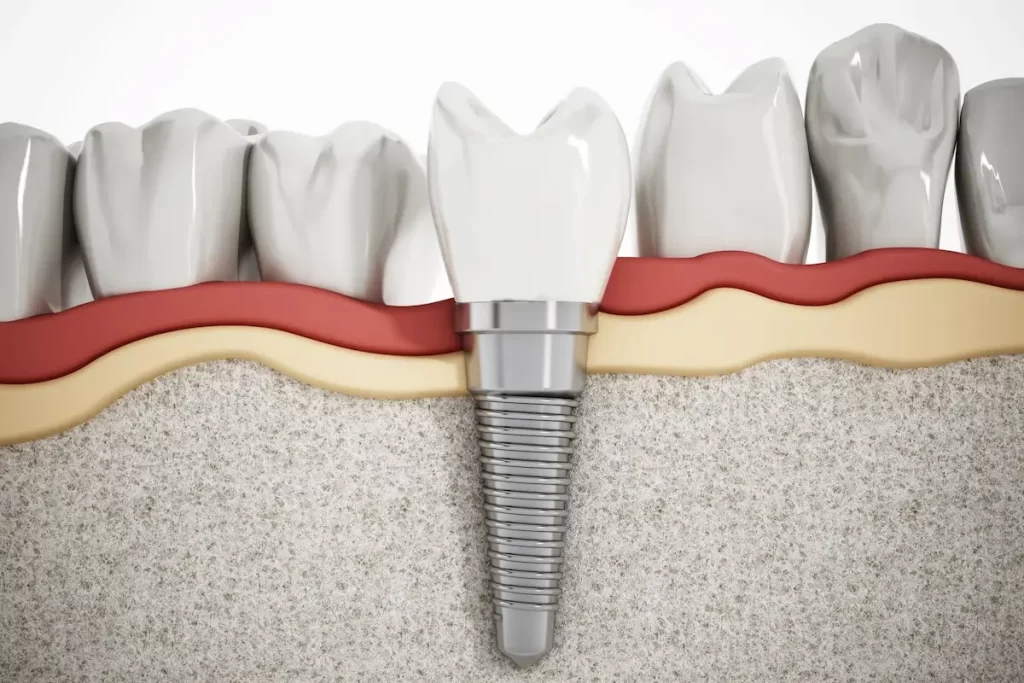
A dental implant is a titanium post placed into the jawbone to act as an artificial tooth root. Once the implant fuses to the bone — a process that typically takes several months — it provides a permanent, stable foundation for a crown, bridge, or denture attachment above the gumline.
Implants are the preferred option for replacing missing teeth when the goal is to avoid compromising adjacent healthy teeth. Unlike a bridge, which requires filing down the neighboring teeth for support, an implant stands entirely on its own. They can replace a single tooth, multiple teeth, or be used to anchor a full set of implant-supported dentures — eliminating the movement and discomfort that comes with traditional dentures affected by bone loss.
Our office works with experienced oral surgeons for implant placement, and we handle the restoration — the attachment, crown, or bridge — in-house.
Bone Grafting
A successful implant requires sufficient jawbone density to support it. When a tooth has been missing for an extended period, the surrounding bone deteriorates — sometimes to the point where implant placement isn’t immediately possible. Bone grafting restores that lost material and makes implants viable again.
The procedure is more routine than it sounds. A grafting material — which can come from your own body, a donor source, animal tissue, or synthetic alternatives — is placed into the affected area through a small incision. Over time, your body deposits new bone cells around the material until the graft is replaced entirely by natural bone. Depending on the extent of deterioration, full healing can take up to seven months before implant placement proceeds.
Fixed (Implant-Supported) Dentures
For patients missing a full arch of teeth, implant-supported fixed dentures offer a significant upgrade over conventional removable dentures. Anchored by as few as four to six implants per arch, they stay firmly in place while eating and speaking, look and feel like natural teeth, and actively prevent the jawbone deterioration that traditional dentures accelerate.
After implant placement and a healing period for osseointegration — the process by which titanium fuses to living bone — your final set of teeth is attached. Most patients describe the result as indistinguishable from natural teeth in both appearance and function.
Why Implants Over Other Options
Bridges and removable dentures are less expensive upfront, but both carry long-term trade-offs. Bridges require altering adjacent healthy teeth and can make those teeth more susceptible to decay over time. Removable dentures press on the bone ridges beneath them, continuing the bone loss that started when the teeth were lost. Implants are the only tooth-replacement option that actively stimulates the jawbone and prevents further deterioration — which is why their 95%+ success rate and lifetime durability make them the best long-term value in most cases.
Dental Crowns
A crown restores a damaged, decayed, or weakened tooth back to its natural shape, size, and function. The right crown material depends on the tooth’s position in the mouth, its condition, and factors like grinding or clenching habits.
We offer several crown types:
All-porcelain / Lava crowns are metal-free restorations reinforced with a zirconia interior for strength while maintaining the natural translucency of real enamel. These are ideal anywhere in the mouth — particularly front teeth — and are the preferred choice for patients with metal allergies.
Porcelain-fused to gold (Captek crowns) are lined with 24K yellow gold on the interior. Research supports that pure gold inhibits bacterial accumulation around crown margins, reducing the risk of recurrent decay and gum irritation. The result is a crown that performs well clinically and avoids the gray metal line at the gumline common with standard porcelain-fused-to-metal crowns.
Full gold crowns remain the most durable option for posterior molars, heavy grinders, and cases where maximum strength is the priority over aesthetics.
All our crowns are fabricated by top local dental labs to ensure fit, function, and longevity.
Dental Bridges
A bridge is a fixed restoration used to replace one or more missing teeth. It consists of two crowns on either side of the gap — placed over the adjacent teeth — with the replacement tooth (or teeth) suspended between them. The result is a natural-looking, non-removable solution that restores the contour of your smile and maintains the proper bite relationship between upper and lower teeth.
Bridges are a reliable option when implants aren’t feasible or when adjacent teeth already require crowns. We’ll help you weigh the trade-offs honestly so you can make the decision that makes sense for your specific situation.